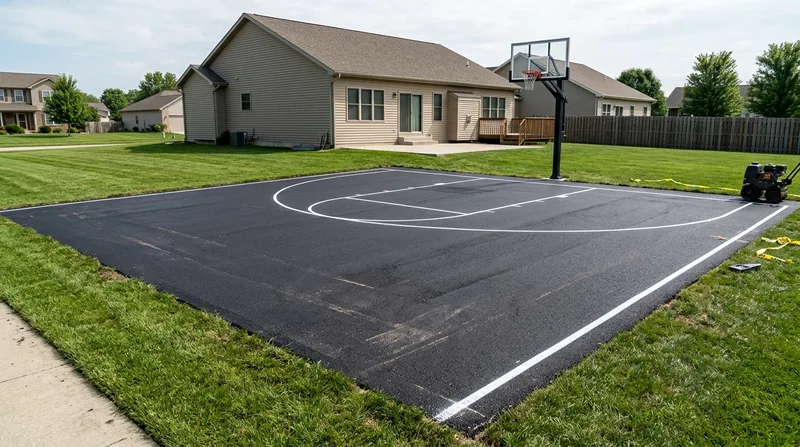




Sports Court & Path Paving in Decatur gives schools, subdivisions, and community centers a durable playing surface built on the same prairie subgrade that challenges every driveway in Macon County. Decatur's flat terrain and deep black silt loam soil, rich enough to have earned the city the name Soybean Capital, also means that any court or path laid directly on that soft base will heave, crack, and fail within a season or two. A proper sports court starts with a full stone base, graded and compacted to shed water away from the soft subgrade beneath, then finished with smooth, properly pitched asphalt that drains toward the edges and holds up through the freeze-thaw swings of a central Illinois winter. We handle the entire job: site grading, base preparation, and the paving itself, so the court or path you get is built to play on, not just to look finished.
Why Proper Grading and Base Matter for Sports Courts Near Decatur
A basketball or tennis court in Decatur sits on soil that holds water like a sponge. The glacial till and prairie silt loam under most residential and institutional property in Macon County drains poorly, especially in the low spots where spring storms leave standing water for days. If asphalt is laid directly over that wet, soft subgrade, the base will fail within the first freeze cycle. Water trapped beneath the surface expands when it freezes, heaving the court upward and cracking it from underneath. By the second or third winter, alligator cracking spreads across the surface, the court becomes unplayable, and the money spent on paving is lost.
- We excavate the site and remove any topsoil or unsuitable material down to stable subgrade.
- We spread and compact a full stone base, typically 4 to 6 inches of crushed limestone or recycled asphalt millings, to create a permeable layer that sheds water sideways and downward away from the paving.
- We proof-roll the base under heavy equipment to ensure it will not settle or rut under the weight of play and maintenance traffic.
- We then pave a smooth, properly pitched surface that slopes gently toward the edges so rain runs off instead of pooling at the net or sideline.
The result is a court that drains, stays flat, and holds up through the seasonal swings that break poorly built surfaces.
Key info: Schools in Forsyth and Mount Zion have learned this the hard way. A court built on a skim of asphalt over dirt will fail in two to three years. A court built with a proper base will play for fifteen to twenty years with routine maintenance.
How We Build a Sports Court or Path in Decatur: Step by Step
Every court or path job in Decatur starts with a site visit and measurement. We assess the existing grade, check for drainage problems, identify any utilities that must be located before we dig, and confirm the final surface elevation with the school or property manager. Then we move forward in stages, each one essential to a court that will hold up for years.
- We call 811 and mark all underground utilities before any excavation begins, as required by Illinois law.
- We strip and remove topsoil, organic material, and any soft or unsuitable subgrade material.
- We bring in and compact a full stone base, typically 4 to 6 inches, and proof-roll it to confirm stability and proper drainage.
- We lay asphalt in two lifts (base course and wearing course) for durability, compacting each layer to specification.
- We finish with a smooth, properly pitched surface that sheds water and is ready for play or foot traffic.
The entire job, depending on court size and site conditions, typically takes one to two weeks from start to finish.
Local example: A 4,000-square-foot basketball court in Forsyth with soft subgrade and poor drainage required full excavation, a 6-inch stone base, and two-lift asphalt paving. The job took ten working days. The court has been in service for five years with no cracking or settlement.
For more information on how we prepare sites for other paving projects, see our Gravel Driveway Installation & Grading page, which covers the same base-prep principles that apply to courts and paths.
Sports Court and Path Paving Methods in Decatur
| Method | Description | Best for |
|---|---|---|
| Full Excavation and Base Build | Remove soft subgrade, install 4 to 6 inches of compacted stone base, then pave with two-lift asphalt. | New courts on poor or wet subgrade; sites that have failed before; institutional projects requiring long service life. |
| Base Improvement and Paving | Excavate selectively to remove standing water or soft spots, add stone base where needed, then pave. | Existing paths or courts with localized drainage problems; sites with stable subgrade in some areas and soft subgrade in others. |
| Recycled Asphalt Base with New Paving | Use recycled asphalt millings (RAP) as the base layer, compacted over prepared subgrade, then top with new asphalt. | Budget-conscious projects; sites where the existing asphalt can be milled and reused; paths and secondary courts. |
| Paving Over Existing Stable Base | If an existing base is sound and well-drained, mill the old surface and pave new asphalt on top. | Resurfacing an existing court or path that has held up but is worn or cracked on the surface only. |
Each method is chosen based on site conditions, drainage, and the expected life of the court. We assess the site and recommend the approach that will give you the longest service and the best value.
Sports Court and Path Paving Cost in Decatur: What to Expect
A sports court or path in Decatur typically starts at $8,500 to $12,000 for a small court or path (under 2,000 square feet) with straightforward site conditions and a solid, well-drained base. The cost rises with court size, the amount of excavation and base work required, site access, and the complexity of drainage. A full-size basketball court (4,000 to 5,000 square feet) on soft subgrade requiring complete excavation and a 6-inch stone base will run $15,000 to $25,000 or more. A walking path of 500 to 1,000 square feet on stable ground may run $3,500 to $6,000.
The biggest cost driver is how much digging and base work the site needs. If the ground is soft, wet, or has poor drainage, we must excavate deeper, import more stone, and spend more time on grading and compaction. If the site is already relatively level and well-drained, the cost is lower. Access also matters: if trucks can reach the site easily, the job costs less. If we must hand-carry materials or work around obstacles, labor increases.
We always provide a written estimate with tonnage and thickness specifications before work begins, so you know exactly what you are paying for and why. For detailed pricing information and to discuss your specific project, visit our pricing page or call us at (217) 859-8789 for a free estimate.
What to Look for When Hiring a Sports Court Paving Contractor Near Decatur
A sports court or path is an investment that will serve a school, community center, or subdivision for fifteen to twenty years if it is built right, or fail in two to three years if corners are cut on the base. Choosing the right contractor matters. Here is what to verify before you sign a contract.
- Ask the contractor to show proof of full insurance coverage, including general liability and workers compensation, and verify the policy is current.
- Request a written estimate that includes site measurements, base depth and material, asphalt thickness, tonnage, and the method of construction, not just a price.
- Get at least two or three estimates so you can compare approach, materials, and price.
- Ask for references from similar projects completed in the last three to five years, and call at least one reference to ask about drainage, durability, and the contractor's responsiveness.
- Confirm whether the Decatur city or village where the court sits requires a building permit for paving, and ask the contractor whether they will help you navigate the permit process.
- If the court is in an HOA or school district, verify that any architectural or design standards are met before work begins.
- Avoid contractors who offer a price without visiting the site, pressure you to decide quickly, ask for a large cash deposit, or have out-of-state plates.
We are fully insured and provide free written estimates with full specifications. We have been in business since 2016 and serve Decatur and the surrounding area. To discuss your project and get a no-obligation estimate, contact us or call (217) 859-8789.
Sports Court & Path Paving in Decatur: Pricing Guide
| Service | Price | Details |
|---|---|---|
| Small court or path (under 2,000 sq ft) | Starting at $8,500 | Basic excavation, 4-inch stone base, two-lift asphalt, proper pitch for drainage. |
| Standard basketball or tennis court (3,500 to 5,000 sq ft) | Starting at $15,000 | Full site excavation, 6-inch stone base, compaction, two-lift asphalt, drainage design, surface finish. |
| Walking path or secondary court (500 to 1,500 sq ft) | Starting at $3,500 | Selective excavation, 4-inch base, light compaction, one or two-lift asphalt, basic drainage pitch. |
| Complex site with poor drainage or soft subgrade | On estimate | Site visit required to assess excavation depth, base material, and grading scope before pricing is set. |
| Estimate and site visit | Free | Written estimate with measurements, materials, tonnage, and thickness. Response within 24 hours at (217) 859-8789. |
Indicative pricing, the exact cost depends on square footage, finish, and site access. Free personalized estimate within 24h at (217) 859-8789.


